Streaming Quality and Ultra-Low Latency
Executive Summary
- Streaming workflows are described as needing explicit attention to both quality and latency, with tooling choices affecting outcomes.
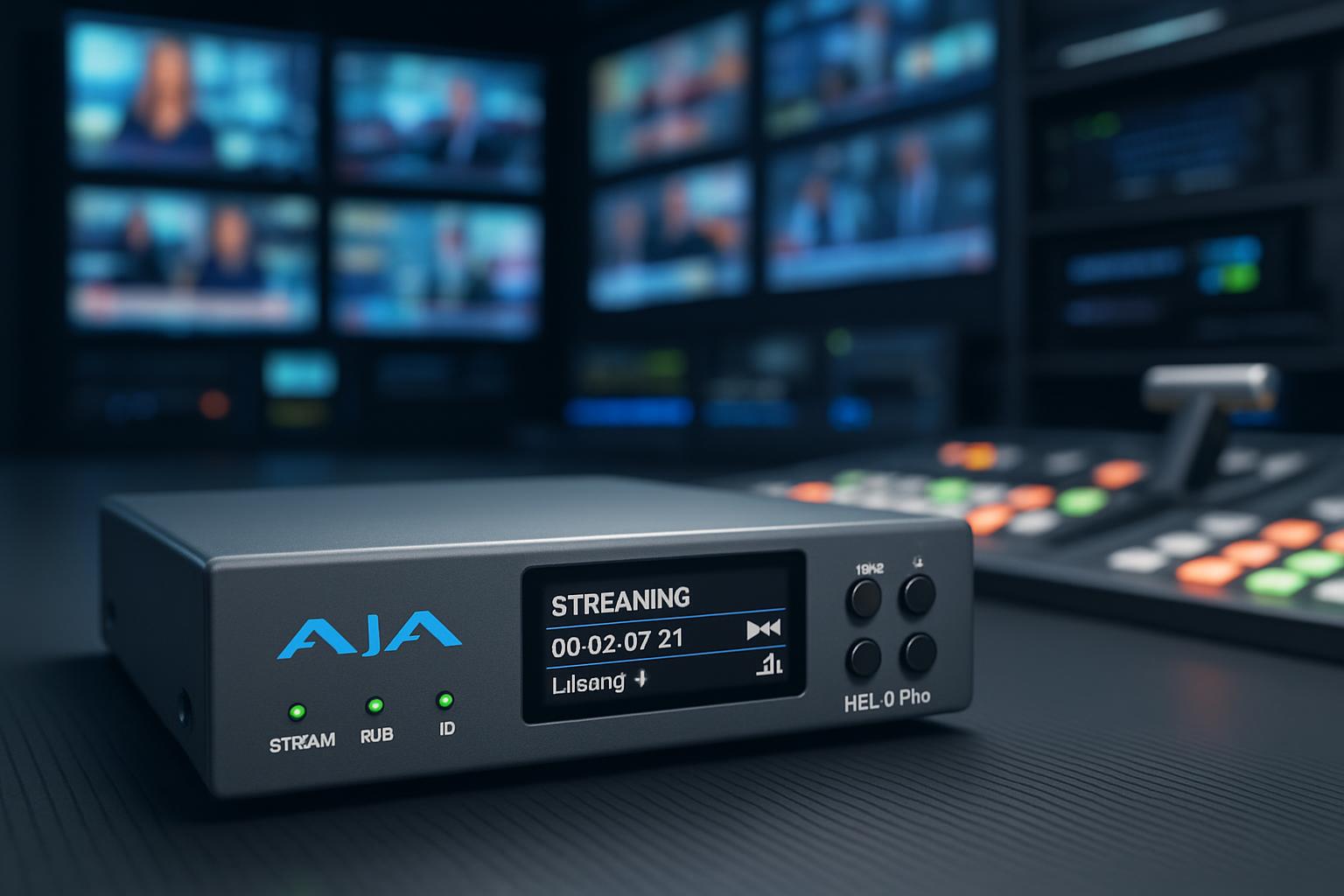
- AJA’s HELO Plus is positioned as an H.264 streamer/recorder used to deliver live streams and create recordings, tying encoding/recording hardware to operational streaming needs.
- WebRTC is framed as an opportunity for ultra-low-latency streaming, particularly for large sports-streaming operators, alongside constraints around maintaining OTT features such as SSAI and DRM.
Key Industry Developments
- Quality and latency as primary stream attributes
- Delivering a “standout stream” is explicitly linked to managing both quality and latency, indicating that stream performance is not treated as a single-variable optimization.
- The emphasis on latency alongside quality implies that streaming operators may need to evaluate workflow components (capture, encode, transport, playback) through both lenses rather than focusing only on visual fidelity.
- Hardware encoding/recording in live workflows
- AJA’s HELO Plus is described as an “H.264 streamer/recorder,” placing H.264 encoding and recording capabilities in a single device category used for live streaming and recording outputs.
- The device is discussed in the context of delivering live streams and recordings, reflecting a workflow where a single system can support both real-time distribution and archival capture.
- WebRTC for ultra-low-latency at scale, with OTT feature constraints
- WebRTC is described as a “real opportunity for ultra-low-latency streaming,” highlighting it as a candidate protocol/technology for reducing end-to-end delay.
- Large sports-streaming operators are described as unable to “swap the ability to stream content in real time” for “basic OTT functionality like SSAI and DRM,” framing a technical and product requirement to preserve ad insertion and content protection while pursuing lower latency.
Real-World Use Cases
- Live streaming plus recording with an H.264 streamer/recorder
- AJA’s HELO Plus is presented for delivering live streams, indicating a practical deployment where H.264 encoding is used for real-time output.
- The same device is also used to create recordings, supporting a use case where a live event workflow includes simultaneous recording for later use.
- Ultra-low-latency streaming for sports operators using WebRTC
- WebRTC is positioned for ultra-low-latency streaming for large sports-streaming operators, aligning the technology with use cases where real-time delivery is a core requirement.
- The use case is bounded by the requirement to retain OTT capabilities such as SSAI and DRM, meaning the workflow must support ad insertion and rights protection without sacrificing real-time performance.
Why It Matters
- Quality and latency are coupled operational targets
- The explicit pairing of quality and latency suggests that improving one dimension without managing the other may not meet the goal of a “standout stream,” making measurement and tuning across both dimensions a practical necessity.
- Workflow consolidation can support both distribution and capture
- Using an H.264 streamer/recorder for both live streams and recordings indicates a workflow pattern where a single component can serve real-time delivery and recording needs, potentially simplifying operational setups that require both outputs.
- Ultra-low-latency ambitions must coexist with OTT requirements
- For large sports-streaming operators, the constraint that they “can’t afford” to trade real-time streaming for SSAI and DRM frames a compatibility requirement: low-latency approaches must integrate with ad and protection systems rather than displacing them.
Sources
- https://www.streamingmedia.com/Articles/Editorial/Spotlights/How-to-Elevate-the-Quality-of-Your-Video-Stream-With-AJA-HELO-Plus-165574.aspx
- https://www.streamingmedia.com/Articles/Columns/Future-in-Focus/Is-2024-the-Year-of-WebRTC-162262.aspx
Related News

Haivision Adds Live Video to TAK Enhancing ISR
Live Video in TAK - Haivision describes the use of Tactical Assault Kit (TAK) operations in defense, public safety, and ISR contexts, with an emphasis on live video as...
Read More →
Bridge Technologies and Heynen expand IP monitoring for production visibility
Bridge Technologies described an expanded partnership with Heynen in the Netherlands, moving from a reseller agreement to a broader Business Partner collaboration. The...
Read More →
MediaKind Akamai Plan World Cup Streaming Capacity
MediaKind described operational and workflow considerations for large-scale live streaming tied to the 2026 World Cup, including concurrency, event volume, and deliver...
Read More →