← Back to News
AWS Elemental Intel Deploy Cost-Efficient Video Super-Resolution
Published on September 12, 2024
Video Workflows: Super-Resolution and Live Encoding
Executive Summary
- Two workflow areas are described: a scalable video super-resolution pipeline built on AWS Batch with the Intel Library for Video Super Resolution (VSR), and next-generation AWS Elemental Live L900 series hardware for on-premises encoding and IP video workflows.
- The super-resolution material focuses on improving archival SD sources for modern distribution, with both subjective comparison and objective measurement using VMAF.
- The encoding hardware material focuses on density expansion and transitions from SDI to uncompressed IP, including SMPTE ST 2110, SMPTE 2022-6, JPEG XS, and packet-level failover with SMPTE 2022-7.
Key Industry Developments
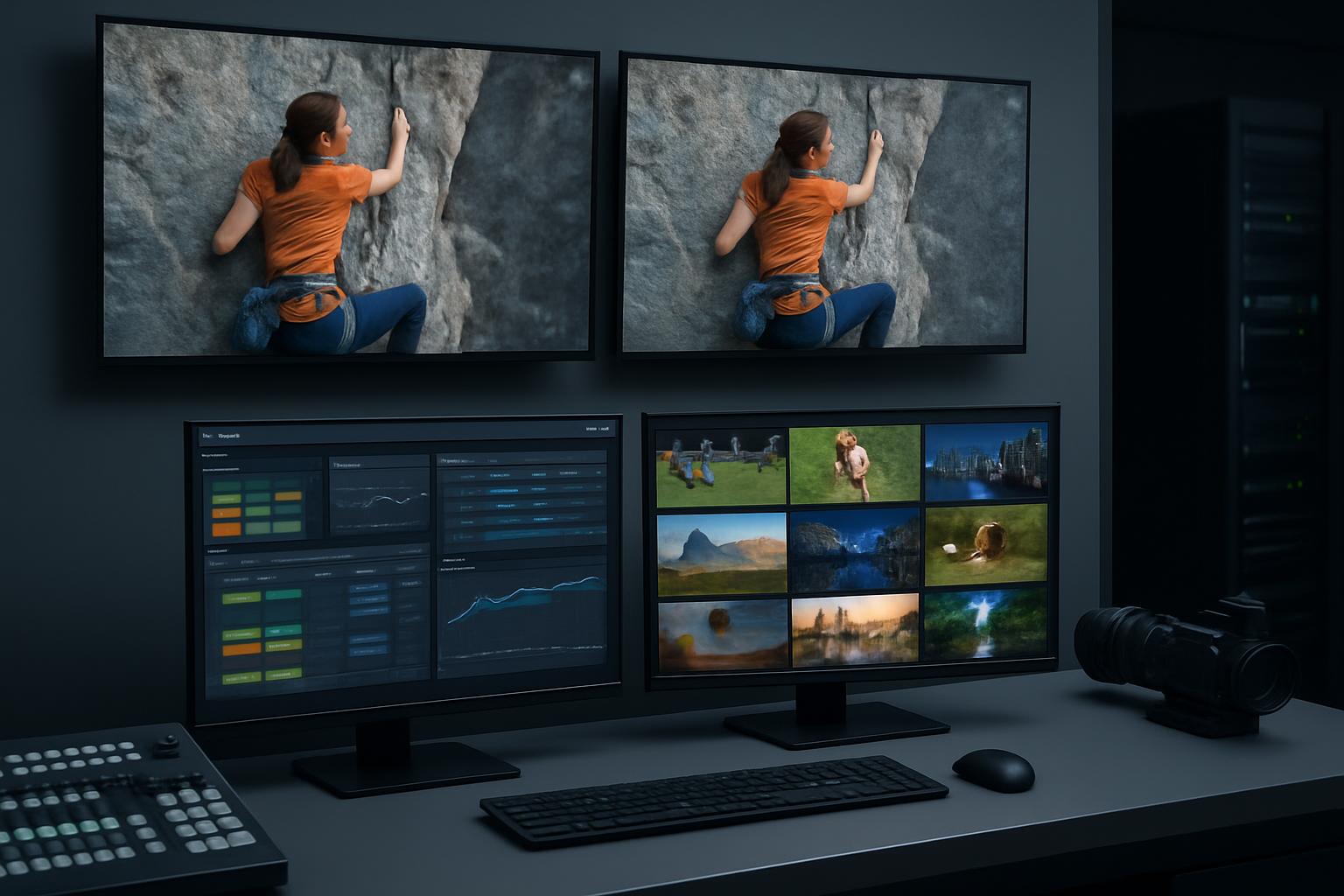
- AWS and Intel describe a cost-efficient approach to video super-resolution using AWS Batch and the Intel Library for VSR, positioned as an alternative to traditional upscaling methods (for example, Lanczos and bicubic) that can introduce artifacts such as blurring and pixelation.
- The super-resolution implementation is presented as a step-by-step workflow deployed via an AWS CloudFormation template, using Amazon S3 for inputs and outputs and AWS Batch jobs to process video assets. The described setup includes verifying that two S3 buckets exist:
vsr-inputandvsr-output. - The Intel Library for VSR workflow is stated to require specific Amazon EC2 instance types, including
c5.2xlarge,c6i.2xlarge, andc7i.2xlarge, indicating that compute selection is a defined part of the deployment constraints. - AWS describes the next generation of AWS Elemental Live L900 series appliances and positions the L900 Appliance Edition encoders to expand density while transitioning on-premises infrastructure from SDI to uncompressed IP. The L920, L940, and L980 models are described as supporting one or more UHD HEVC workflows and multiple HDR protocols, with optional uncompressed IP inputs and outputs.
- The L900 series is described as having two SKU lines: one dedicated to uncompressed IP workflows and one for compressed network and SDI workflows. For uncompressed IP, the supported technologies listed include SDI and SMPTE ST 2110, SMPTE 2022-6, and JPEG XS; packet-level failover is described via red/blue network configurations using SMPTE 2022-7 on “-U” IP L900 appliances.
- AWS Elemental Live encoders are described as usable for contribution to Amazon S3, AWS Elemental MediaConnect, or AWS Elemental MediaLive, supporting hybrid on-premises to cloud contribution patterns.
Real-World Use Cases
- Archival enhancement and repurposing
- The super-resolution workflow is framed around enhancing archival SD content for modern platforms and devices, with the goal of upscaling and sharpening low-resolution footage into high-definition outputs.
- The workflow is described as integrating into existing transcoding pipelines through AWS Batch automation, using S3 buckets as the ingress/egress points (
vsr-inputandvsr-output) for video assets. - Quality evaluation workflows for super-resolution
- Subjective evaluation is described using the
compare-videotool, while objective evaluation is described using VMAF, enabling a workflow that pairs visual inspection with a metric-based assessment. - On-premises encoding and IP transition
- The L900 Appliance Edition encoders are positioned for customers transitioning on-premises infrastructure from SDI to uncompressed IP, including workflows involving SMPTE ST 2110 and SMPTE 2022-6, and optionally JPEG XS.
- The L920/L940/L980 appliances are described as supporting UHD HEVC workflows and multiple HDR protocols, aligning with UHD/HDR channel encoding requirements.
- Contribution from on-premises encoders to AWS services
- AWS Elemental Live encoders are described as contributing to Amazon S3, AWS Elemental MediaConnect, or AWS Elemental MediaLive, supporting architectures where on-premises encoding feeds cloud-based processing and distribution.
Why It Matters
- Operationalizing super-resolution at scale
- The described super-resolution approach ties enhancement processing to AWS Batch and a CloudFormation-deployed workflow, which can standardize deployment and job execution patterns for processing multiple assets through S3-based input/output buckets.
- The explicit EC2 instance-type requirement (
c5.2xlarge,c6i.2xlarge,c7i.2xlarge) indicates that compute planning is part of making the workflow reproducible and deployable within defined infrastructure constraints. - Measurable quality control
- Pairing subjective comparison (via
compare-video) with objective scoring (via VMAF) provides a concrete mechanism to evaluate super-resolution outputs beyond visual preference alone. - Clear protocol and SKU delineation for live workflows
- The L900 series’ separation into uncompressed IP versus compressed network/SDI SKU lines maps hardware selection to I/O and transport requirements, including SDI, SMPTE ST 2110, SMPTE 2022-6, JPEG XS, and SMPTE 2022-7 failover for “-U” appliances.
- Support for UHD HEVC workflows and multiple HDR protocols on specific models (L920/L940/L980) provides a defined appliance path for UHD/HDR encoding needs.
- Hybrid contribution options
- The ability to contribute from AWS Elemental Live encoders to Amazon S3, AWS Elemental MediaConnect, or AWS Elemental MediaLive supports multiple downstream workflow designs, from file-based handoff (S3) to live transport and processing services.
Sources
- https://aws.amazon.com/blogs/media/creating-scalable-super-resolution-workflow-leveraging-intel-library-for-video-super-resolution/
- https://aws.amazon.com/blogs/media/next-generation-aws-elemental-live-hardware-unlocks-new-possibilities-for-video-workflows/
Related News
Haivision Adds Live Video to TAK Enhancing ISR
Live Video in TAK - Haivision describes the use of Tactical Assault Kit (TAK) operations in defense, public safety, and ISR contexts, with an emphasis on live video as...
Read More →
Bridge Technologies and Heynen expand IP monitoring for production visibility
Bridge Technologies described an expanded partnership with Heynen in the Netherlands, moving from a reseller agreement to a broader Business Partner collaboration. The...
Read More →
MediaKind Akamai Plan World Cup Streaming Capacity
MediaKind described operational and workflow considerations for large-scale live streaming tied to the 2026 World Cup, including concurrency, event volume, and deliver...
Read More →