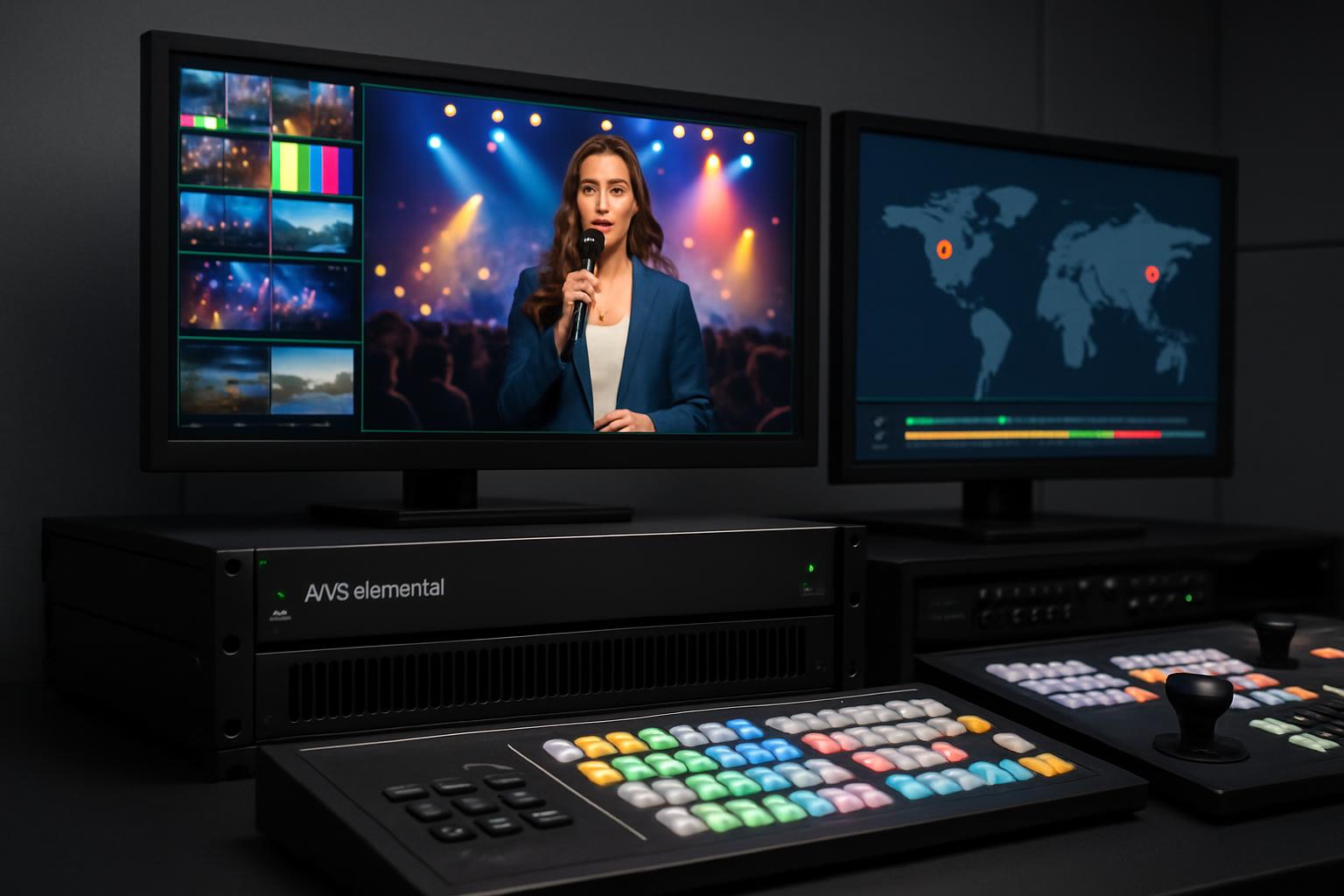
Streaming Localization Workflows
Executive Summary
- A modular approach to localization and accessibility can be added to a live streaming architecture by selecting specific integration points in the workflow.
- A typical AWS-based live streaming chain is described as MediaConnect for transport, MediaLive for transcoding, MediaPackage for origin, and CloudFront for distribution.
- Integration points 2 and 3 are recommended because they reduce touch points and simplify integration and deployment.
Key Industry Developments
- The described reference architecture places localization and accessibility functions at multiple possible integration points across a live pipeline that includes AWS Elemental MediaConnect, AWS Elemental MediaLive, AWS Elemental MediaPackage, and Amazon CloudFront.
- Integration point 2 embeds captions before MediaLive transcoding and supports multiple caption-related formats and workflows:
- CEA-608 embedding can be performed before transcoding.
- DVB Subtitle can be handled for pass-through or burn-in use cases via MediaLive.
- DVB Teletext can be converted to WebVTT for OTT streaming.
- CEA-608 embedded captions have explicit constraints: language support is limited to Latin-based languages and the number of caption tracks is limited to four (CC1–CC4).
- Integration point 3 appends subtitle and audio dubbing tracks into an existing main manifest and performs time alignment, using HLS WebVTT for subtitle integration. This integration point is described as having no limitations on language support.
Real-World Use Cases
- Live captioning and translation workflows can be implemented to automatically generate captions and translations in multiple languages for live streams, including the use of a live captioning and dubbing service (SyncWords) and the mention of Amazon Nova or other generative AI services for subtitle translation.
- Pre-transcode caption embedding (integration point 2) can be used to embed 608 captions into a live stream before MediaLive transcoding, with the operational implication that language requirements should be checked against 608 protocol support and track limits (CC1–CC4).
- Post-transcode subtitle augmentation (integration point 3) can be used to add subtitle tracks after transcoding by augmenting an HLS playlist with multiple language subtitle tracks, with time alignment performed as part of appending subtitle and audio dubbing tracks into the existing main manifest.
- Client-side processing (integration point 4) is described as requiring changes to the video player to process subtitles and audio dubbing, including browser-based approaches such as iFrame embedding.
Why It Matters
- Choosing an integration point affects language coverage and operational constraints: 608 embedding supports only Latin-based languages and up to four caption tracks, while manifest-based subtitle integration via HLS WebVTT is described as having no language limitations.
- The architecture highlights concrete workflow boundaries—transport (MediaConnect), transcoding (MediaLive), origin (MediaPackage), and distribution (CloudFront)—that can be used to place localization components with fewer touch points when using recommended integration points 2 and 3.
- The described decision areas include determining language requirements, assessing whether languages are supported by the 608 protocol, evaluating live dubbing needs, defining latency requirements, and determining whether the stream is for live events or 24×7 broadcast channels.
Sources
- https://aws.amazon.com/blogs/media/live-streaming-localization-and-accessibility-using-aws-media-services/
Related News
Haivision Adds Live Video to TAK Enhancing ISR
Live Video in TAK - Haivision describes the use of Tactical Assault Kit (TAK) operations in defense, public safety, and ISR contexts, with an emphasis on live video as...
Read More →
Bridge Technologies and Heynen expand IP monitoring for production visibility
Bridge Technologies described an expanded partnership with Heynen in the Netherlands, moving from a reseller agreement to a broader Business Partner collaboration. The...
Read More →
MediaKind Akamai Plan World Cup Streaming Capacity
MediaKind described operational and workflow considerations for large-scale live streaming tied to the 2026 World Cup, including concurrency, event volume, and deliver...
Read More →