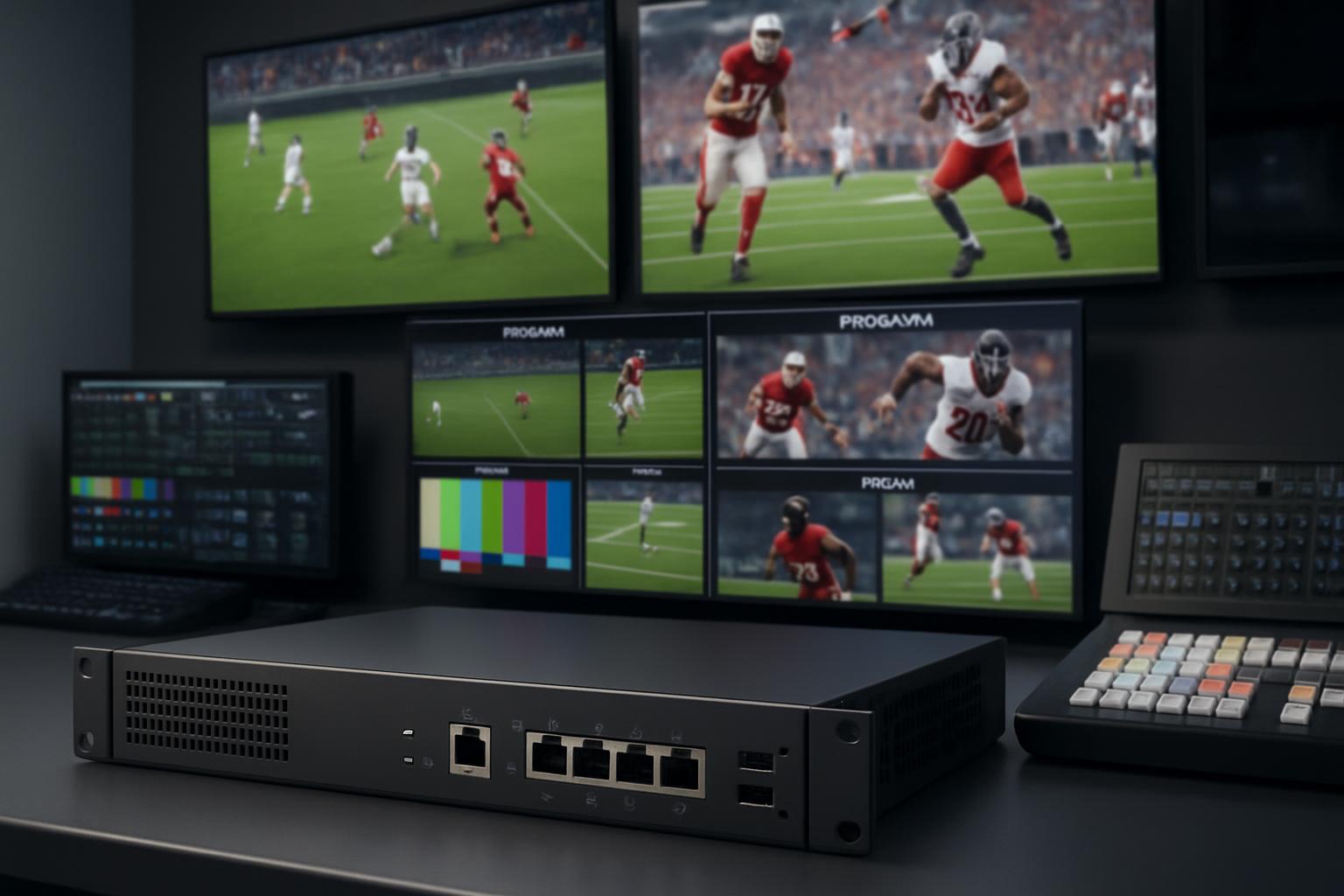
StreamingMedia Unveils Rack-Mount AV-over-IP Center for Highlights-First Sports
Published on May 20, 2026
Unified Media Centers, Highlights-First Viewing
Executive Summary
AV-over-IP infrastructure and live sports streaming strategy are being framed around two operational needs: centralized control of complex media workflows and adapting viewing experiences to “highlights first” audience behavior. One product description emphasizes a compact, rack-mountable unified media center that combines compute, switching, and server components for centralized management. One industry viewpoint argues that linear, start-to-finish game viewing can be “less than satisfying” for Gen Z viewers who prioritize highlights, and links league relevance to “moving with the times.”
Key Industry Developments
- Kiloview positioned the Cradle Series RF02 as a compact rack-based AV-over-IP platform, described as “a groundbreaking, compact 2RU AV-over-IP solution.”
- The RF02 is described as integrating multiple infrastructure elements into one system: “an 18-card system, a high-bandwidth network switch, and KiloLink Server Pro.”
- The RF02 is presented as a centralized operations approach, pairing “centralized management” with “complete and flexible workflows.”
- A live sports streaming perspective highlights a shift in audience expectations, emphasizing “anticipating and serving the needs of 'highlights first' Gen Z viewers” as a stated priority.
- Linear, start-to-finish viewing is characterized as a weaker fit for that audience segment, with “linear, lean-back, beginning-to-end game-viewing” described as “less than satisfying.”
- Maintaining league relevance is explicitly tied to adaptation, described as “critical to moving with the times and maintaining major sports leagues' relevance.”
Real-World Use Cases
- Centralized management of AV-over-IP resources using a unified 2RU system that combines an 18-card architecture, an integrated network switch, and a server component intended to support “centralized management.”
- Operating “complete and flexible workflows” under a centralized management model, as described for the RF02’s role as a unified media center.
- Designing live sports streaming experiences around “highlights first” consumption patterns, based on the stated need to anticipate and serve Gen Z viewers who prioritize highlights.
- Re-evaluating linear, beginning-to-end game presentation for audiences described as finding that mode “less than satisfying,” implying alternative packaging or navigation aligned to highlights-first behavior.
Why It Matters
- Consolidating AV-over-IP components into a compact 2RU footprint can change how teams deploy and manage media infrastructure, particularly when the system is described as integrating cards, switching, and a server element in one unit. This framing emphasizes operational centralization rather than distributed point solutions.
- Centralized management is explicitly linked to “complete and flexible workflows,” suggesting that workflow design and day-to-day operations are a primary value proposition of unified media centers, not only hardware density.
- For sports streaming, the stated gap between “highlights first” preferences and “linear, lean-back” viewing indicates that audience satisfaction can depend on how content is packaged and presented, not only on stream availability.
- The argument that league relevance is “critical” to “moving with the times” frames highlights-first adaptation as a strategic requirement for major sports leagues, rather than an optional feature.
Sources
- https://www.streamingmedia.com/Articles/Editorial/Spotlights/Hot-Products-Kiloview-Cradle-Series-RF02-The-Ultimate-Unified-Media-Center-171256.aspx
- https://www.streamingmedia.com/Articles/Columns/Editors-Note/Untethered-Broadcasting-Where-the-Live-Sports-Streaming-Puck-Is-Going-171245.aspx
Related News
S4C Launches Freely Channel with AWS Elemental Pipeline
S4C built a production-ready live TV pipeline on AWS Elemental Media Services to launch its channel on Freely. The workflow combines live encoding, packaging, server-s...
Read More →
Bridge Technologies VB440 Enables ST 2110 PTP Validation
Broadcast production workflows are described as operating across SDI, IP-native, and hybrid SDI/IP environments, with SDI still widely used and hybrid operation presen...
Read More →
Haivision Launches Live Video Platform Improving Broadcast Workflow
Haivision published a post titled “Haivision NAB 2026: Live Video Innovation.” The available extracted material does not include additional technical details, product...
Read More →