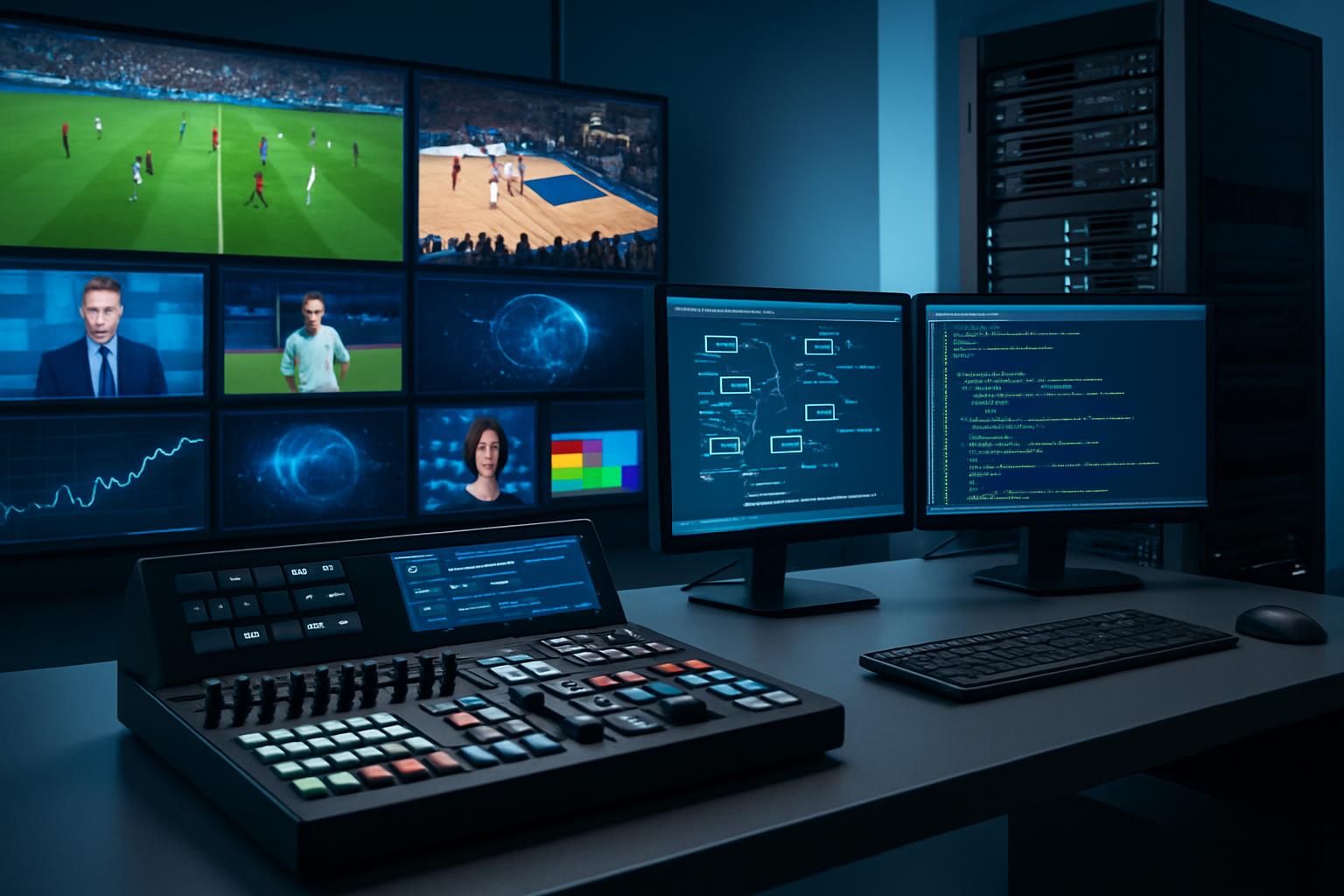
Agentic AI in Media
Executive Summary
- Two AWS reference architectures describe AI-assisted media workflows: an agentic content system for sports publishing and a serverless, event-driven pipeline for a short-form video streaming platform.
- One implementation reports generating “around 1200+ pieces of content every week” at “less than 25 cents” per item, alongside a “95% cost reduction.”
- Another implementation describes AI-driven subtitle translation and poster generation for a multilingual VOD catalog, reporting a “95% reduction in subtitle translation time.”
Key Industry Developments
- Agentic content creation for sports publishing (PGA TOUR on Amazon Bedrock)
- A distributed network of specialized AI agents is used to research, create, validate, and publish content with minimal human intervention, with Amazon Bedrock as the foundation for the workflow.
- Research agents integrate directly with the PGA TOUR API through custom Python functions to retrieve real-time and historical golf data, enabling data-backed generation rather than purely freeform text creation.
- Validation is described as automated fact-checking, brand voice compliance checks, and visual asset evaluation, positioning validation as a first-class step before publication rather than a manual editorial-only gate.
- Amazon CloudWatch is integrated for real-time performance monitoring and automated alerting, indicating operational observability is built into the content pipeline.
- AI-enhanced streaming platform architecture (Dramaze on AWS)
- Netmedias launched Dramaze.com as a freemium video-on-demand platform for short-form drama episodes across Asia and the Middle East, with an initial processing and distribution target of 2,400 videos and a plan to scale to 9,600 videos over 12 months.
- The platform delivers subtitles in nine languages and uses AI-driven features for automated subtitle translation and poster generation, with Amazon Bedrock used for translation and poster frame selection.
- Amazon Nova Pro is used for frame analysis and ranking suggestions, tying poster selection to model-assisted scoring rather than manual curation.
- The media processing workflow is described as fully serverless and event-driven: AWS Lambda executes functions, Amazon EventBridge coordinates events, AWS Elemental MediaConvert produces adaptive bitrate outputs and converts to HLS, and Amazon CloudFront distributes processed video with low latency.
Real-World Use Cases
- High-volume sports content generation and publishing
- Round recaps and tournament recaps can be generated and published within minutes of live sports events, aligning the workflow with near-real-time publishing requirements for sports coverage.
- The same generation capabilities are used to create both short-form social media posts and long-form articles, indicating reuse of underlying content generation components across multiple output formats.
- Betting profiles for players in a tournament field and shot commentaries for every shot in a golf tournament are included as supported content types, expanding coverage beyond only marquee storylines and top players.
- Automated validation checks factual accuracy and brand voice compliance before publication, and also evaluates player images and graphics against brand guidelines, combining text and visual governance in one pipeline.
- Multilingual short-form VOD processing, localization, and delivery
- Automated subtitle translation is implemented using Amazon Bedrock, supporting delivery of content with subtitles in nine languages and reducing manual localization effort.
- Poster generation and poster frame selection are automated with generative AI, with Amazon Nova Pro providing frame analysis and ranking suggestions to guide selection.
- Video transcoding is handled by AWS Elemental MediaConvert to produce adaptive bitrate streams and convert outputs to HLS, enabling standard HTTP-based streaming delivery.
- Viewer entitlement validation and geographic restriction enforcement are performed in real time using Lambda@Edge and AWS WAF, placing access control at the edge in front of content delivery.
Why It Matters
- Cost and throughput implications for content operations
- The PGA TOUR implementation reports generating around 1200+ pieces of content per week while spending less than 25 cents per generated piece, and it reports a 95% cost reduction, framing agentic workflows as a mechanism for scaling output while lowering unit economics.
- The Dramaze implementation reports a 95% reduction in subtitle translation time, connecting AI-assisted localization directly to operational cycle-time improvements.
- Workflow design patterns: agent networks vs. event-driven pipelines
- The sports publishing system emphasizes specialized agents that research via API integration, generate content, and validate outputs (fact-checking, brand voice, and visual asset evaluation) before publication, with CloudWatch used for monitoring and alerting.
- The streaming platform emphasizes a serverless, event-driven architecture coordinated by EventBridge and Lambda, with MediaConvert producing adaptive bitrate HLS outputs and CloudFront distributing content, while WAF and Lambda@Edge enforce protection and entitlement checks.
- Technical standardization and governance
- HLS is explicitly used as the streaming output format via AWS Elemental MediaConvert, aligning the delivery pipeline with a widely supported HTTP streaming protocol.
- Both implementations include operational monitoring via Amazon CloudWatch, indicating observability is treated as part of production readiness for AI-assisted media workflows.
Sources
- https://aws.amazon.com/blogs/media/accelerating-sports-content-creation-usingagentic-ai-pga-tour/
- https://aws.amazon.com/blogs/media/how-aws-powers-dramaze-ai-enhanced-streaming-platform/
Related News
Haivision Adds Live Video to TAK Enhancing ISR
Live Video in TAK - Haivision describes the use of Tactical Assault Kit (TAK) operations in defense, public safety, and ISR contexts, with an emphasis on live video as...
Read More →
Bridge Technologies and Heynen expand IP monitoring for production visibility
Bridge Technologies described an expanded partnership with Heynen in the Netherlands, moving from a reseller agreement to a broader Business Partner collaboration. The...
Read More →
MediaKind Akamai Plan World Cup Streaming Capacity
MediaKind described operational and workflow considerations for large-scale live streaming tied to the 2026 World Cup, including concurrency, event volume, and deliver...
Read More →