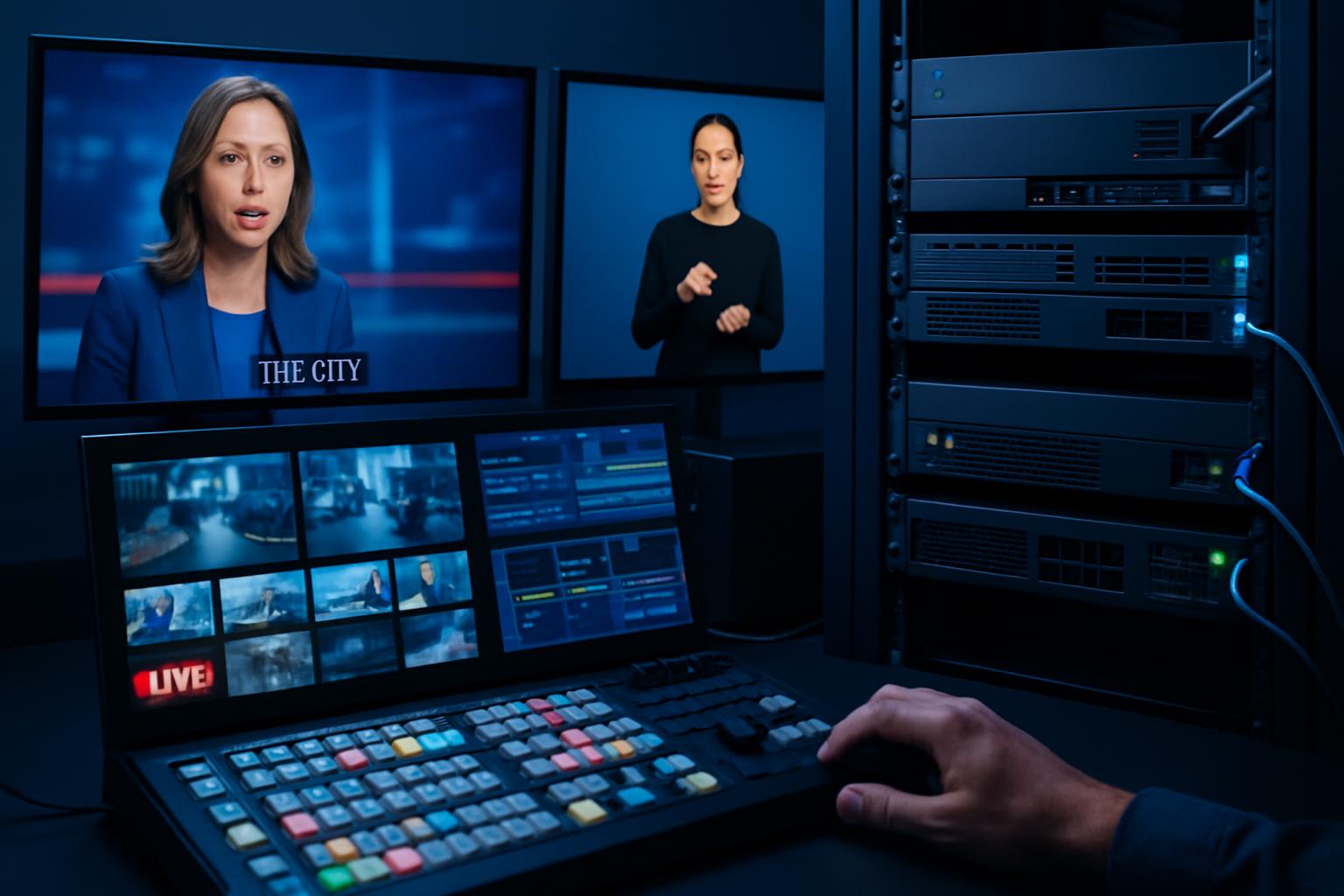
AWS Streaming and Accessibility
Executive Summary
- Two AWS-focused media topics are covered: selecting live streaming architectures for broadcast and digital-native needs, and implementing accessibility services for TV and internet delivery.
- The live streaming guidance distinguishes between traditional broadcasters modernizing infrastructure and digital-native companies adding interactive features, noting that AWS Elemental services and Amazon IVS can be combined in a single workflow.
- Accessibility coverage describes captions, subtitles, and audio description across broadcast and IP delivery, including OTT caption sidecar formats such as TTML and WebVTT and audio description mixing in AWS Elemental MediaConvert.
Key Industry Developments
- AWS Elemental Media Services is positioned as an integrated suite for video workflows, described as processing, delivering, and monetizing live and on-demand video at scale.
- AWS Elemental MediaConnect is described as a content transport service with multi-Availability Zone redundancy and support for multiple protocols, aligning with contribution and distribution needs where reliability and redundancy are required.
- AWS Elemental MediaLive is described as generating adaptive bitrate (ABR) outputs and supporting Media Quality Confidence Scores (MQCS) with CMAF outputs, tying encoding decisions to measurable quality indicators and modern packaging formats.
- AWS Elemental MediaPackage is described as accepting HLS and CMAF inputs and delivering outputs in CMAF, traditional HLS, and low-latency HLS (LL-HLS), supporting multi-device ABR delivery and lower-latency playback options.
- Amazon Interactive Video Service (Amazon IVS) is described as a managed live streaming solution that automatically handles processing and delivery and transcodes incoming streams into adaptive bitrate HLS outputs. It also offers two latency modes: Low-latency Streaming (2–3 seconds delay) and Real-time Streaming (sub-300 millisecond latency).
- Accessibility services are framed around standards for TV services and internet delivery, with captions/subtitles and audio description presented as core mechanisms. The material also states that accessibility features are essential for migration to OTT distribution platforms.
Real-World Use Cases
- Contribution and transport into cloud workflows
- On-premise encoding for content contribution can support multicast IP, SDI, and SMPTE 2110 sources, enabling integration with existing broadcast facilities and IP-based production environments.
- Secure content transport to the cloud is described using SRT and Zixi outputs, and MediaConnect is described with multi-AZ redundancy for reliable ingest and output paths.
- Live channel creation, packaging, and delivery
- Cloud-native live channel delivery is described using MediaLive to generate ABR outputs based on customer requirements, with packaging via MediaPackage to deliver CMAF, HLS, and LL-HLS outputs.
- Hybrid live channel workflows are described for organizations maintaining existing hardware investments while adopting cloud services for parts of the pipeline.
- Content protection and monetization
- Content protection is described using SPEKE with DRM systems including FairPlay, Widevine, and Microsoft PlayReady, aligning encryption and key exchange with multi-DRM playback requirements.
- Ad targeting and server-side ad insertion (SSAI) are described using AWS Elemental MediaTailor, including support for overlay ads and standard ad protocols; overlay ads are described for HLS and DASH streams containing SCTE-35 markers.
- Interactive and ultra-low-latency experiences
- Interactive shopping and virtual events are described using low-latency streaming with 2–3 seconds of delay.
- Live gaming, sports betting, and interactive education are described using real-time streaming with sub-300 millisecond latency, and Amazon IVS Stage is described for multiple participants in virtual events at sub-300 millisecond latency.
- Built-in chat is described via Amazon IVS Chat to increase viewer engagement.
- Accessibility implementation across broadcast and OTT
- MPEG Transport Streams (MPEG TS) are described as carrying captions and subtitles to support viewers with auditory disabilities, while captions are described as providing the full audio experience for deaf and hard of hearing viewers.
- OTT caption delivery is described using sidecar text files such as TTML and WebVTT synchronized to video time codes, and accessibility features (audio description, subtitles, sign language) are described as being indicated in an electronic program guide for OTT streams.
- Audio description is described as providing additional context during natural pauses, and audio description mixing is described as available with AWS Elemental MediaConvert.
Why It Matters
- Live streaming architectures often need to balance contribution formats (multicast IP, SDI, SMPTE 2110), transport protocols (including SRT and Zixi), and redundancy (multi-AZ) with downstream packaging targets (CMAF, HLS, LL-HLS). The described AWS services map these concerns to discrete workflow stages: transport (MediaConnect), encoding/ABR generation (MediaLive), and packaging (MediaPackage).
- Latency requirements directly influence platform choices and feature sets. The described Amazon IVS modes provide explicit latency targets—2–3 seconds for low-latency streaming and sub-300 milliseconds for real-time streaming—supporting use cases where interactivity depends on tighter end-to-end delay budgets.
- Accessibility requirements span both traditional broadcast constructs (captions/subtitles in MPEG TS) and OTT delivery patterns (TTML/WebVTT sidecars). The described shift from RF broadcast to IP delivery (IPTV and OTT) makes these features part of core distribution design rather than optional enhancements.
- The guidance explicitly notes that AWS Elemental services and Amazon IVS can be used together, enabling architectures that combine broadcast-grade contribution/packaging and monetization components with interactive, low-latency experiences.
Sources
- https://aws.amazon.com/blogs/media/choosing-the-right-aws-live-streaming-solution-for-your-use-case/
- https://aws.amazon.com/blogs/media/back-to-basics-accessibility-services-for-media/
Related News
Haivision Adds Live Video to TAK Enhancing ISR
Live Video in TAK - Haivision describes the use of Tactical Assault Kit (TAK) operations in defense, public safety, and ISR contexts, with an emphasis on live video as...
Read More →
Bridge Technologies and Heynen expand IP monitoring for production visibility
Bridge Technologies described an expanded partnership with Heynen in the Netherlands, moving from a reseller agreement to a broader Business Partner collaboration. The...
Read More →
MediaKind Akamai Plan World Cup Streaming Capacity
MediaKind described operational and workflow considerations for large-scale live streaming tied to the 2026 World Cup, including concurrency, event volume, and deliver...
Read More →