← Back to News
Haivision SRT with Makito X Enables Low-Latency Contribution
Published on March 13, 2026
SRT Streaming and Command Centers
Executive Summary
- Two deployments illustrate different operational requirements for video: low-latency contribution over public internet for live news production, and integrated visual collaboration for public safety operations.
- The examples center on specific products and workflows: Secure Reliable Transport (SRT) with Haivision Makito X encoders/decoders and a KB encoder for CDN delivery; and Haivision Command 360 with video wall components and Alpha FX for situational awareness and non-technical operation.
- One implementation includes an explicit operational deadline tied to the Republican National Convention in August of 2020.
Key Industry Developments
- Public-internet contribution using SRT and dedicated encoders/decoders
- A live production workflow was built to transport “high quality, low latency video using public internet connections” from multiple party headquarters to a centralized production center.
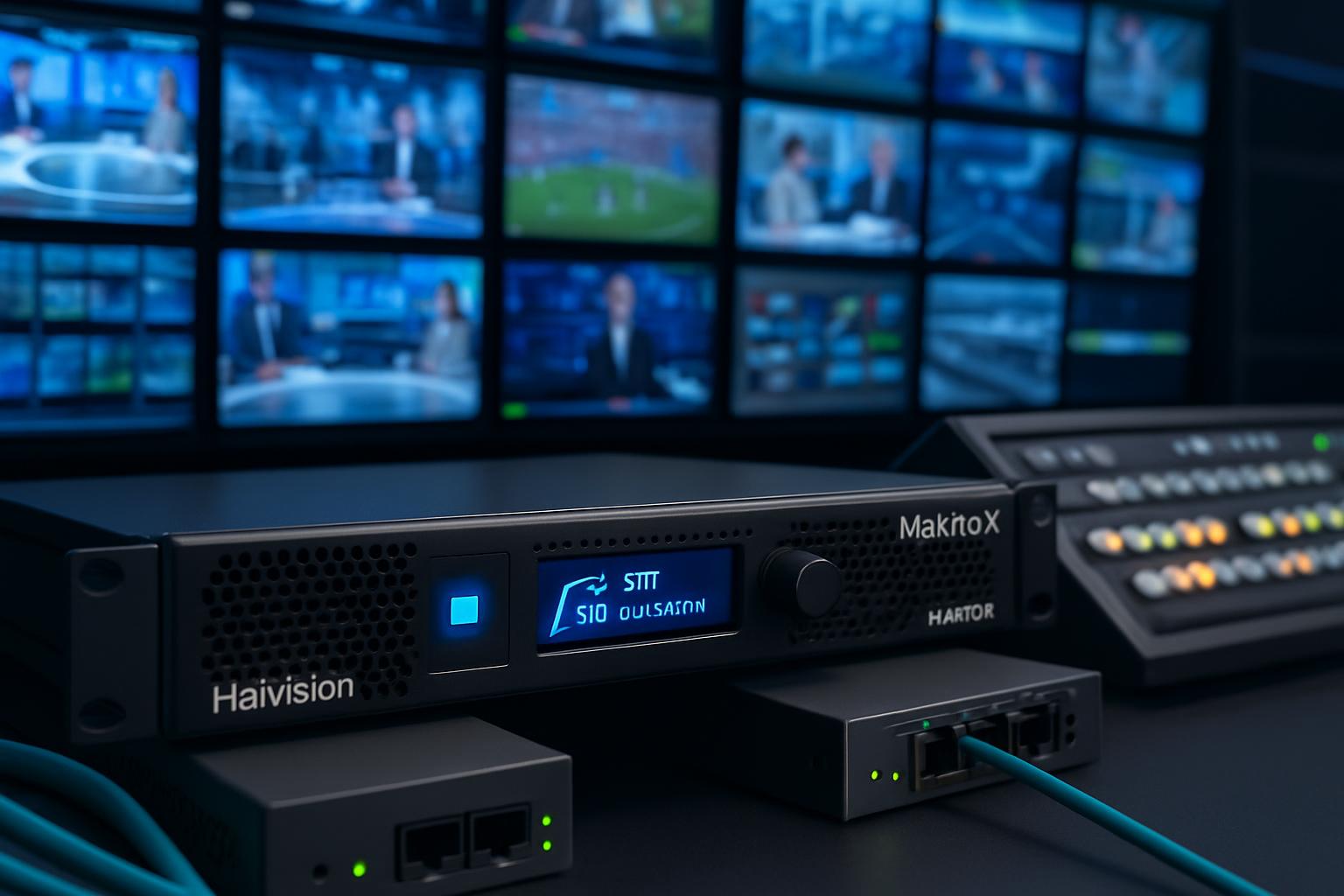
- The contribution chain used Haivision Makito X devices, explicitly including a Makito X H.264 Encoder and a Makito X HEVC Decoder, with Secure Reliable Transport (SRT) identified as the transport protocol.
- CDN distribution from a produced stream
- After production, Haivision’s KB encoder was used to send the produced live stream to a CDN for delivery to BILD.DE and social media platforms, separating contribution transport from distribution delivery.
- Integrated command-center visualization for public safety operations
- A public safety operations environment was revamped due to limitations in an existing RTCC and command center technology, specifically because it was not tightly integrated with a Video Management System (VMS) managing over 700 cameras. This lack of tight integration constrained response speed and collaboration.
- The selected solution emphasized situational awareness and a video wall designed for non-technical users, enabling staff to create and modify video wall layouts without extensive training.
- The product set identified for this environment includes Haivision Command 360, Video Wall Components, and Alpha FX.
Real-World Use Cases
- Election-night live streaming from multiple locations
- BILD worked with Camcast to produce a live streaming experience for online audiences covering German election results, with feeds transported from party headquarters to the BILD production center.
- The transport requirement focused on maintaining low latency and reliability over public internet connections, implemented using SRT with Makito X encoders/decoders as the contribution mechanism.
- The produced program output was encoded via Haivision’s KB encoder and sent to a CDN for delivery to BILD.DE and social media platforms, supporting web and social distribution from a single produced stream.
- The outcome reported for the live stream included “hundreds of thousands of live viewers,” indicating audience scale for the online delivery.
- City-scale situational awareness and collaboration
- A city public safety operations setup required monitoring an integrated system of more than 700 IP cameras and license plate readers to provide real-time information to patrol units and command, aligning video monitoring with operational decision-making.
- The environment supported sharing real-time intelligence and enabled non-engineering staff to create and modify video wall layouts, reducing dependence on specialized operators for routine display changes.
- The use cases described include pushing content to a command center video wall using devices brought into the room, and post-incident review and sharing investigative information using RTCC recording capabilities.
Why It Matters
- Protocol- and device-defined contribution workflows enable remote production over public internet
- The election coverage example ties a specific transport protocol (SRT) to specific contribution hardware (Makito X H.264 Encoder and Makito X HEVC Decoder) to meet a stated requirement for high-quality, low-latency video over public internet connections.
- Separating contribution from distribution clarifies operational handoffs
- The workflow explicitly distinguishes between contribution into a production center and distribution outward: a produced live stream was encoded with a KB encoder and delivered to a CDN for BILD.DE and social platforms.
- Integration and usability are operational requirements in command centers
- The public safety case highlights that lack of tight integration with a VMS managing over 700 cameras limited response speed and collaboration, and that the replacement emphasized non-technical operation for creating and modifying video wall layouts.
- Operational deadlines can shape deployment requirements
- The command center system had a stated requirement to be fully operational by the Republican National Convention in August of 2020, indicating a fixed milestone influencing implementation readiness.
Sources
- https://www.haivision.com/case-studies/bild-german-elections/
- https://www.haivision.com/case-studies/charlotte-mecklenburg-police-department/
Related News
Haivision Adds Live Video to TAK Enhancing ISR
Live Video in TAK - Haivision describes the use of Tactical Assault Kit (TAK) operations in defense, public safety, and ISR contexts, with an emphasis on live video as...
Read More →
Bridge Technologies and Heynen expand IP monitoring for production visibility
Bridge Technologies described an expanded partnership with Heynen in the Netherlands, moving from a reseller agreement to a broader Business Partner collaboration. The...
Read More →
MediaKind Akamai Plan World Cup Streaming Capacity
MediaKind described operational and workflow considerations for large-scale live streaming tied to the 2026 World Cup, including concurrency, event volume, and deliver...
Read More →