← Back to News
qibb and AWS Orchestrate Media Workflows Reducing Turnaround
Published on February 20, 2026
AWS-Orchestrated Media Workflows
Executive Summary
- Media teams commonly rely on specialized tools and cloud services that use different metadata formats and lack consistent communication methods.
- qibb is described as a low-code orchestration platform designed for the media industry that uses Amazon Web Service (AWS) Cloud services to streamline operations.
- The described integration approach connects AWS media services and AI/ML services with third-party applications and partner solutions, including tools such as Slack, FFmpeg, Quasar, and Iconik.
- The source states “reductions in content turnaround time by up to 40%,” without detailing measurement methodology.
Key Industry Developments
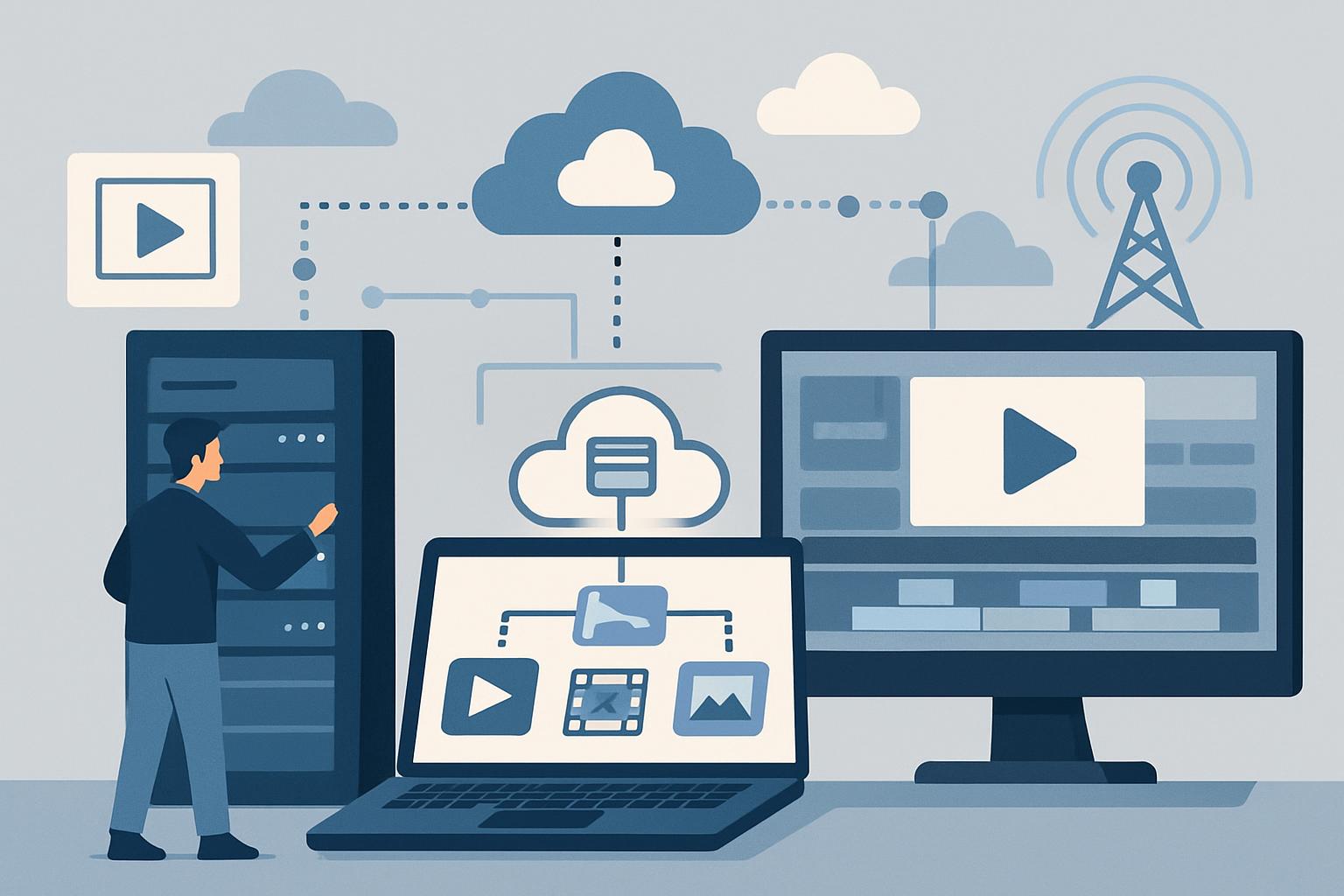
- Orchestration across heterogeneous media stacks
- The source frames a common operational constraint: media workflows span multiple specialized tools and cloud services, and these systems may use different metadata formats and lack consistent communication methods.
- qibb is positioned as an orchestration layer intended to coordinate these systems using AWS Cloud services, rather than requiring a single monolithic toolchain.
- Integration surface spanning storage, media processing, and AI services
- The described integrations include Amazon Simple Storage Service (Amazon S3) for storage, AWS Elemental MediaConnect for media transport, AWS Elemental MediaConvert for transcoding, Amazon CloudFront for delivery, and Amazon S3 Glacier for archiving.
- For analysis and automation, the source lists Amazon Rekognition and Amazon Transcribe, and also states qibb can orchestrate AWS AI and ML services such as Amazon Bedrock and Amazon SageMaker AI.
- Defined workflow patterns presented as “real-world use cases”
- The source enumerates five use cases for integrating qibb with AWS: personalized highlight generation, automated multiplatform distribution, dynamic storage and archive management, multicloud and hybrid workflows, and AI-driven content monetization.
Real-World Use Cases
- Personalized highlight generation (S3-triggered analysis)
- Workflows can be triggered by uploads to Amazon S3, using Amazon Rekognition and Amazon Transcribe to support highlight generation.
- This pattern implies an event-driven pipeline where new media objects in S3 initiate downstream processing steps coordinated by the orchestration layer.
- Automated multiplatform distribution (transcode + route)
- The source describes automated distribution that includes transcoding with AWS Elemental MediaConvert and routing outputs to distribution channels.
- This use case centers on coordinating a repeatable workflow: ingest, transcode, and deliver to multiple endpoints, with the orchestration platform managing the sequence.
- Dynamic storage and archive management (tiering by retention rules)
- The source describes automated tiering between Amazon S3 and Amazon S3 Glacier based on retention rules.
- This use case focuses on lifecycle control: content can move between storage tiers according to policy, with orchestration coordinating the transitions.
- Multicloud and hybrid workflows (on-prem + cloud + MAM)
- The source describes connecting on-premises storage with AWS services and archiving to Amazon S3 or a third-party MAM system.
- This workflow pattern emphasizes interoperability across environments, coordinating movement and processing of assets across on-premises and cloud systems.
- AI-driven content monetization (Bedrock + SageMaker AI orchestration)
- The source describes orchestrating Amazon Bedrock and Amazon SageMaker AI to generate tailored content variations for viewer segments.
- In this pattern, the orchestration layer coordinates AI/ML services as workflow steps, producing multiple versions of content aligned to defined audience segments.
Why It Matters
- Operational coordination across tools with inconsistent metadata and communication
- The source highlights that media teams often operate across specialized tools and cloud services with different metadata formats and inconsistent communication methods, creating friction in end-to-end workflows.
- An orchestration platform is presented as a way to coordinate these systems while continuing to use existing services and applications.
- Workflow automation tied to measurable outcomes (as stated)
- The source states “reductions in content turnaround time by up to 40%,” associating orchestration and integration with efficiency and speed outcomes.
- Relevance to specific media organizations and technical teams
- The source identifies intended stakeholders including broadcasters, streaming platforms, news and sports media outlets, and major film and television studios.
- It also calls out technical teams managing workflows such as live-to-VOD transformation or automated highlight generation, and organizations operating in both on-premises and cloud environments.
Sources
- https://aws.amazon.com/blogs/media/qibb-and-aws-redefine-media-workflows/
Related News
Haivision Adds Live Video to TAK Enhancing ISR
Live Video in TAK - Haivision describes the use of Tactical Assault Kit (TAK) operations in defense, public safety, and ISR contexts, with an emphasis on live video as...
Read More →
Bridge Technologies and Heynen expand IP monitoring for production visibility
Bridge Technologies described an expanded partnership with Heynen in the Netherlands, moving from a reseller agreement to a broader Business Partner collaboration. The...
Read More →
MediaKind Akamai Plan World Cup Streaming Capacity
MediaKind described operational and workflow considerations for large-scale live streaming tied to the 2026 World Cup, including concurrency, event volume, and deliver...
Read More →