← Back to News
Streaming Media: Private 5G Enables Broadcaster Network Control
Published on March 13, 2026
Creator Economy and Controlled Networks
Executive Summary
- Streaming Media 2025 took place October 6–8 in Santa Monica, Calif., and discussions emphasized the rise of the creator economy.
- Conversations focused on the changing economics of content creation, delivery, distribution, and curation, with AI described as playing an ever-larger role in “leveling the playing field” across stages of the workflow.
- In live sports production, 5G was framed as heavily marketed for transformation, while specific promises such as network slicing, guaranteed quality of service, and zero latency were characterized as “few delivered.”
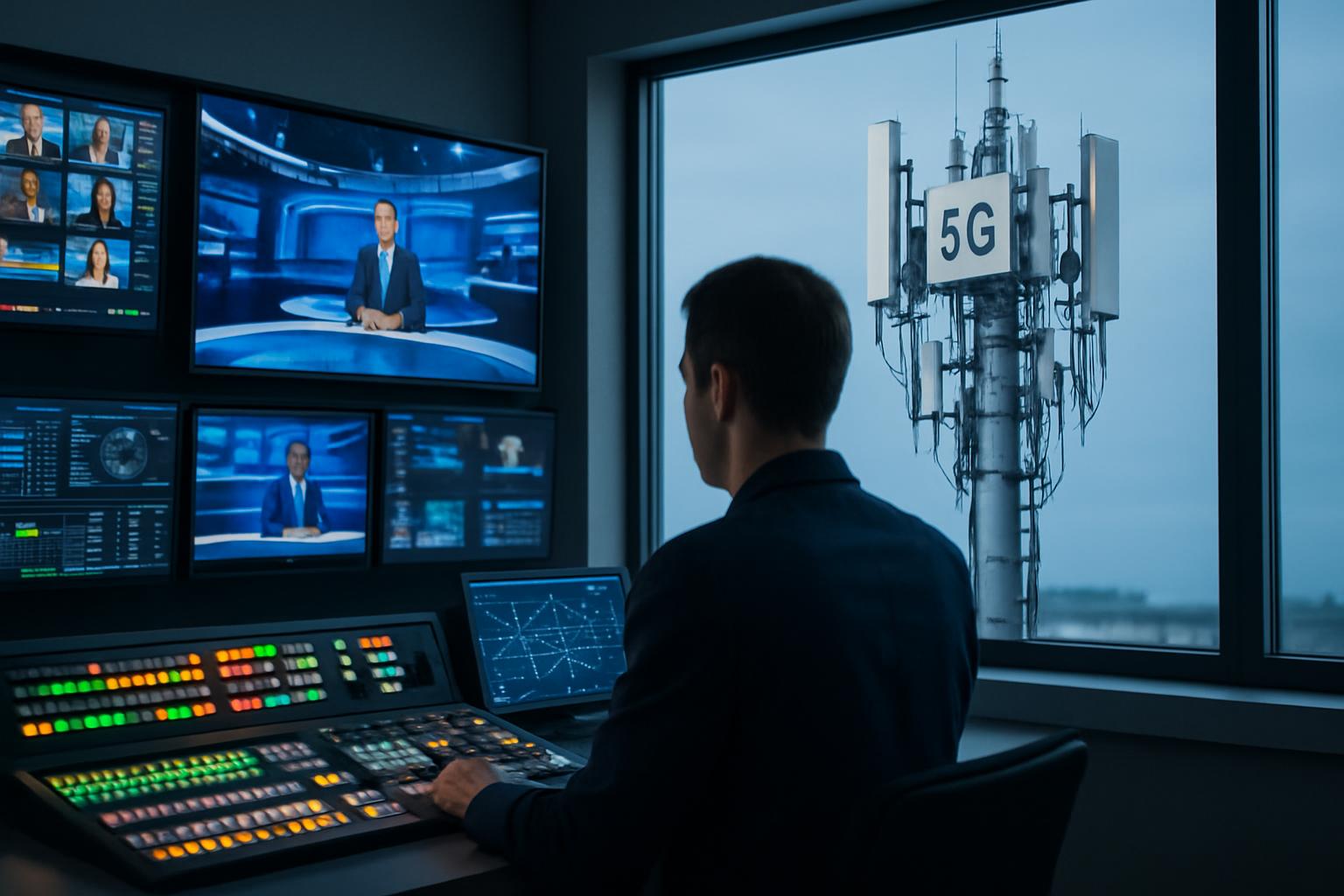
- Private 5G was described as a model that gives broadcasters the ability to design, deploy, and control the network themselves.
Key Industry Developments
- Creator economy as a central streaming theme
- An overarching theme highlighted was “the rise of the creator economy,” positioning creator-led channels and businesses as a core part of streaming’s direction.
- Discussions addressed how creators can “leverage and grow their brands” through evolving business models, with an explicit focus on sustainability (survive and thrive) rather than only audience growth.
- The same set of discussions also pointed to the “unignorable convergence” between creator channels and traditional streaming platforms, indicating that distribution and platform boundaries are being treated as increasingly porous.
- Economics and workflow changes across the streaming pipeline
- The economics of content creation, delivery, distribution, and curation were discussed as changing in tandem, implying that cost structures and value capture are being examined across the full lifecycle rather than in isolated stages.
- AI was described as playing an “ever-larger role” in leveling the playing field at various stages, tying automation and intelligence to multiple points in the pipeline (creation through curation) rather than a single function.
- 5G expectations versus delivered capabilities in live broadcasting
- 5G was described as having been “sold as the technology that would transform live broadcasting,” establishing a gap between marketing narratives and operational outcomes in production environments.
- Specific capabilities were named as promised—network slicing, guaranteed quality of service, and zero latency—while the characterization “few delivered” indicates that broadcasters may not be able to rely on these features as broadly available defaults.
- Private 5G was presented as a practical alternative framing: broadcasters can “design, deploy, and control the network themselves,” shifting responsibility and control toward the production organization rather than a public carrier model.
Real-World Use Cases
- AI-involved content workflows for creators and platforms
- AI involvement was discussed across content creation, delivery, distribution, and curation, indicating use in multiple operational stages rather than only in creative tooling or only in recommendation.
- The stated role of AI in “leveling the playing field” suggests use cases where capabilities become more accessible across participants, potentially affecting how creators and platforms compete across the pipeline.
- Creator brand growth through evolving business models
- Discussions included evolving business models intended to help creators “leverage and grow their brands,” framing monetization and sustainability as part of the operational design of creator-led streaming efforts.
- The convergence between creator channels and traditional streaming platforms was discussed as ongoing, implying practical scenarios where creator distribution strategies and platform strategies intersect rather than remain separate.
- Private 5G for live sports production control
- Live sports production was explicitly tied to private 5G, with the key operational value described as broadcaster control over network design, deployment, and operation.
- The contrast with promised-but-undelivered public 5G capabilities (network slicing, guaranteed QoS, zero latency) positions private 5G as a workflow choice when production teams prioritize controllability over relying on broadly marketed network features.
Why It Matters
- Business and platform strategy
- The rise of the creator economy and the convergence of creator channels with traditional streaming platforms indicate that platform positioning, partnership models, and distribution strategies are being discussed in a blended ecosystem rather than in separate “creator” and “traditional” lanes.
- Changing economics across creation, delivery, distribution, and curation suggests that decisions in one stage can affect viability in others, making end-to-end cost and value analysis a recurring concern.
- Operational control and reliability in live production
- The stated gap between 5G promises and delivery (including network slicing, guaranteed QoS, and zero latency) matters for production planning because it challenges assumptions about predictable performance from marketed capabilities.
- Private 5G’s emphasis on broadcaster-controlled design and deployment highlights a tradeoff: greater control can be treated as a primary requirement in live sports production network planning.
- AI as a cross-stage enabler
- AI being described as increasingly involved across multiple stages of the streaming pipeline matters because it frames AI not as a single tool category, but as a set of capabilities influencing creation through curation.
Sources
- https://www.streamingmedia.com/Articles/Columns/Editors-Note/Farm-to-Table-172819.aspx
- https://www.streamingmedia.com/Articles/Editorial/Featured-Articles/5G-Without-the-Hype-Taking-Control-of-Live-Sports-Production-172374.aspx
Related News
Haivision Adds Live Video to TAK Enhancing ISR
Live Video in TAK - Haivision describes the use of Tactical Assault Kit (TAK) operations in defense, public safety, and ISR contexts, with an emphasis on live video as...
Read More →
Bridge Technologies and Heynen expand IP monitoring for production visibility
Bridge Technologies described an expanded partnership with Heynen in the Netherlands, moving from a reseller agreement to a broader Business Partner collaboration. The...
Read More →
MediaKind Akamai Plan World Cup Streaming Capacity
MediaKind described operational and workflow considerations for large-scale live streaming tied to the 2026 World Cup, including concurrency, event volume, and deliver...
Read More →